Shortcut to Content

Memorial Hall

Patriotic Martyr Maeheon Yun Bong-gil

Exhibition Hall 2

Exhibition Hall 2

Exhibition Hall 2 traces Yun Bong-gil's journey from his arrival in Shanghai, through the Patriotic Deed, his trial and martyrdom, and the post-liberation commemoration efforts, and finally presents Yun Bong-gil as he is remembered today.

The Intro video depicts Yun Bong-gil's solemn determination as he leaves his family and hometown behind on his way to Shanghai.

The Immersive digital content, one of the memorial's signature works, vividly recreates key moments—the day of the Patriotic Deed in Shanghai, the rural enlightenment movement, his martyrdom, and scenes of today's Republic of Korea, which has regained its freedom.

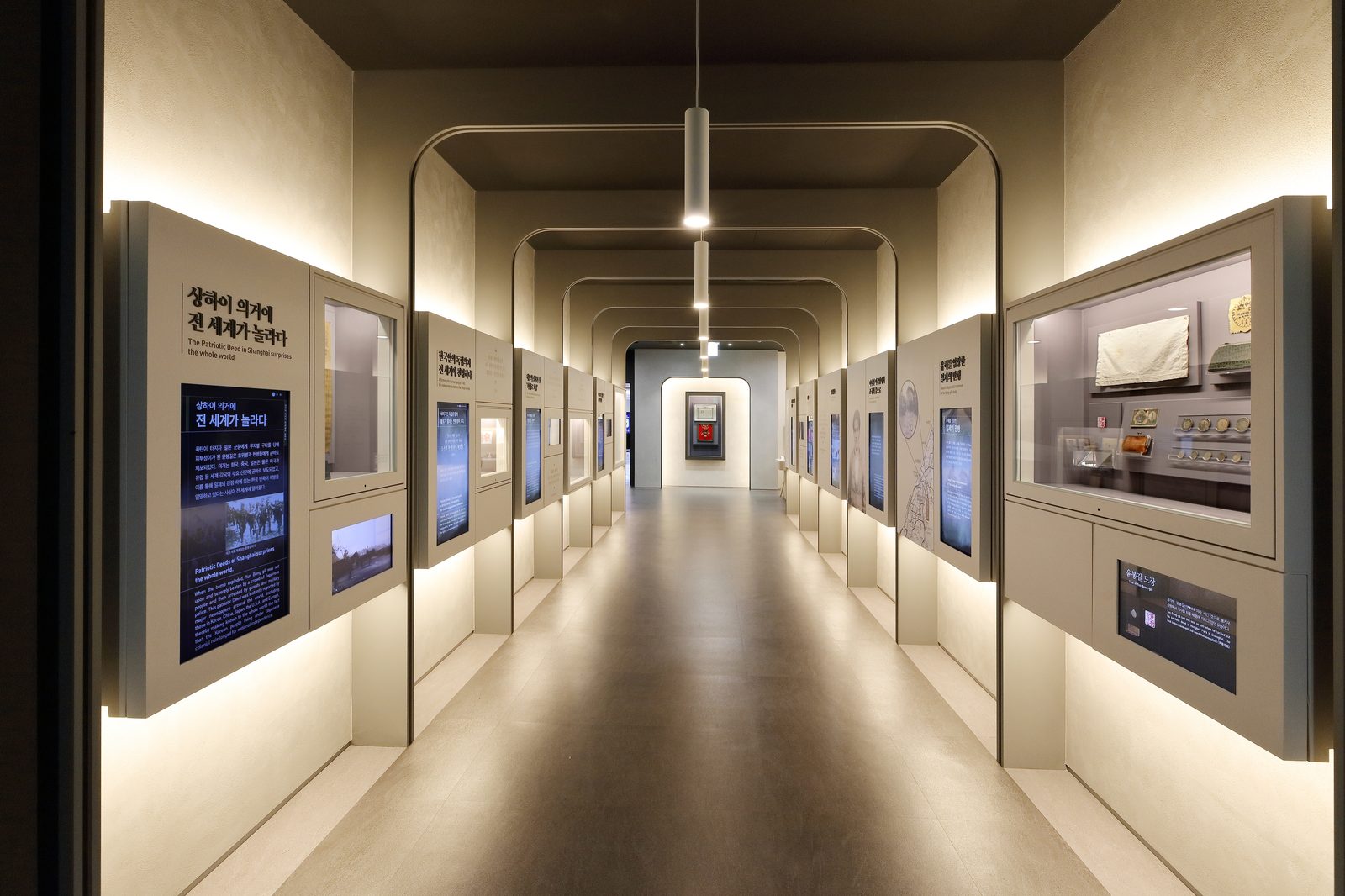
The digital panels in the corridor present images, footage, and archival materials on the Patriotic Deed in Shanghai, Yun Bong-gil's personal belongings, accounts of his martyrdom, the Cairo Declaration, and extensive domestic and overseas memorial initiatives following liberation.

Key Exhibition Items

1
The Way to Shanghai

Intro video introduces Yun Bong-gil's determination and emotional resolve through his poem Ilhyangsi (leaving home), written as he left his loving family and hometown.

2
Immersive Digital Contents

The immersive program titled “For Korean Independence Day” presents vivid scenes of Yun Bong-gil’s departure from his hometown and his commitment to the path of the independence movement, followed by powerful depictions of his life in exile, the Patriotic Deed in Shanghai, and his martyrdom.

3
AI Digital Human

Visitors can engage in one-on-one conversations with AI Yun Bong-gil. His responses are delivered through a vivid, lifelike voice using the Media Table.

4
Digital Panels

Corridor panels showcasing photos, historical videos, personal belongings, martyrdom records, the Cairo Declaration, and domestic/overseas memorial activities.

Featured Artifacts

Written Oath and Photograph (Treasure No. 568)

On April 26, 1932, at the home of An Gong-geun, Yun Bong-gil personally wrote the oath as he held the joining ceremony for the Korean Patriotic Corps.

Yun Bong-gil's Pocket Watch and Kim Gu's Pocket Watch

Yun Bong-gil's pocket watch originally belonged to Baekbeom Kim Gu, who had purchased it for 2 yuan. Before departing for the Patriotic Deed in Shanghai, Yun Bong-gil suggested exchanging it with his own watch, which he had bought for 6 yuan, and thus the two men exchanged watches. Kim Gu's pocket watch on display is the one he received from Yun Bong-gil before the deed. (Yun Bong-gil's Pocket Watch: Treasure No. 568 / Kim Gu's Pocket Watch: Registered Cultural Property No. 441)

A Water-bottle Bomb and a Lunch-box Bomb

The water bottle bomb used at Hongkou Park was designed by Wang Bosiu and manufactured by Xiang Qitao, at the request of Paikbum Kim Gu, who had entrusted the bomb project to Kim Hong-il. The lunch box bomb was carried to the site but was not used.

Manmildae Journal & Osaka Asahi Newspaper

Manmildae Journal is a 40-page document submitted by the Japanese Ministry of the armed forces in 1933, one year after Yun Bong-gil's martyrdom. It includes lawsuit records, reports, photographs, and execution site plans. On May 1, 1932, the Osaka Asahi Newspaper special edition reported the bombing at Hongkou Park, detailing the injuries and deaths of high-ranking Japanese officials, and showing a photo of Yun Bong-gil being taken into custody.

Cairo Declaration & Dowaesilgi

The Cairo Declaration (1943) was the first Allied meeting that guaranteed Korean independence, stating "Korea shall become free and independent" in recognition of Yun Bong-gil's deed. Dowaesilgi ("A True Account of Resisting Japan") was published by Kim Gu in Chinese (1932) to inform the public of patriotic actions, and later translated into Korean (1946) with a preface by Syngman Rhee highlighting the deed as the starting point of liberation.